
A Week Among the Stone Churches: Journeying Through Lalibela's Sacred Labyrinth

Where Rock Becomes Prayer: First Light Over Bete Medhane Alem
I heard Lalibela before I saw it. The plane from Addis Ababa had barely cut its engines at Lalibela Airport, a strip of tarmac about 25 kilometers from town, when a low chant drifted up from somewhere below the escarpment, carried on wind thin with altitude. We were already above 2,500 meters, and the air had that particular highland clarity that makes distant sound travel further than it should.
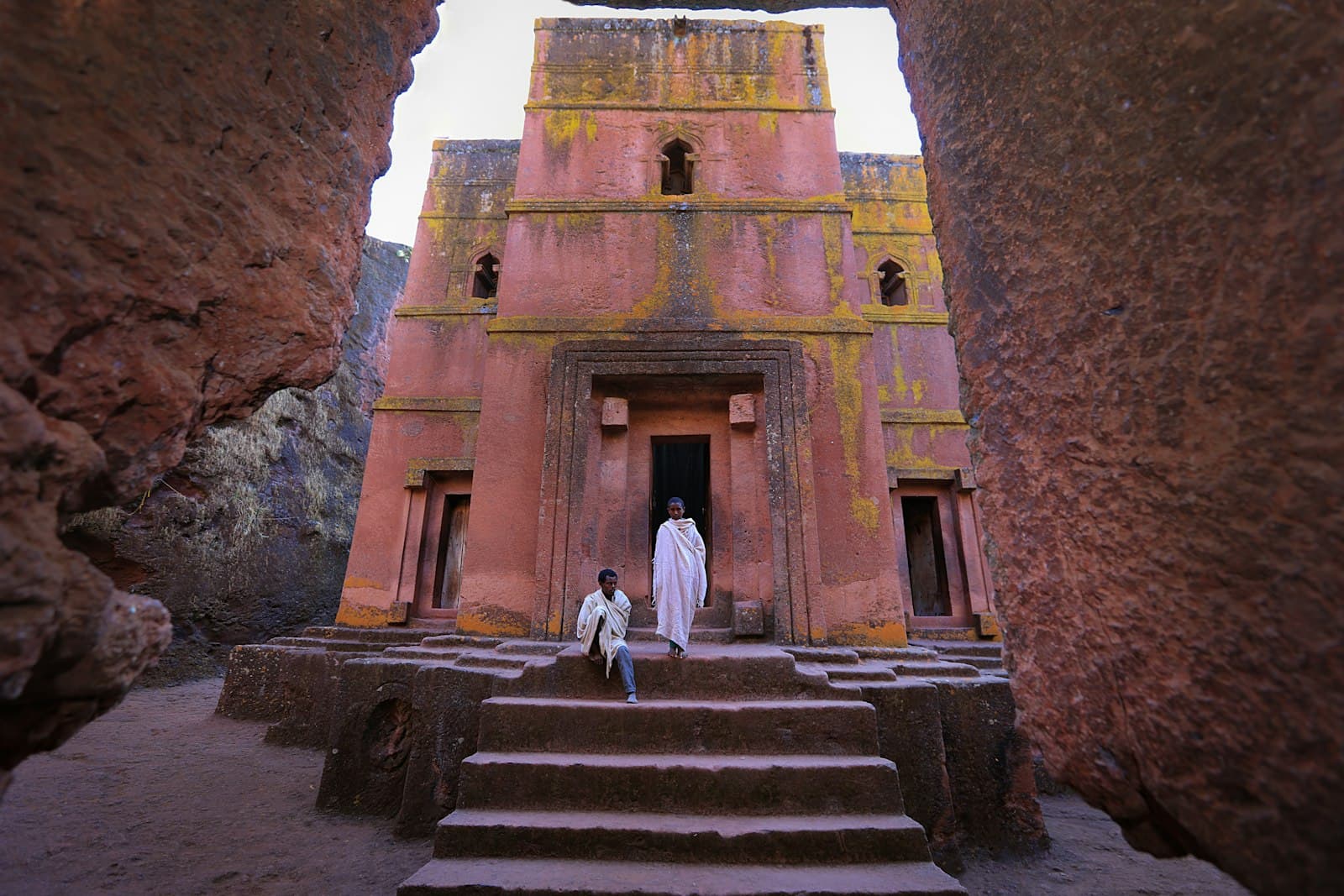
By the time I reached the edge of the Northern Cluster the next morning, before 6 a.m. and still dark, that chant had become a crowd: white-shawled pilgrims descending stone stairways into pits that opened onto churches, not above the ground but below it, hewn from solid rock rather than built upon it. I had read about Lalibela for years. Nothing had told me it would feel less like a monument and more like a working church that happened to be eight centuries old.
“The rock does not remember being cut. It only remembers being prayed in.”
Eleven Churches, Five Mornings: How the Week Actually Unfolded
Arrival, acclimatization, and the Northern Cluster
Ethiopian Airlines runs domestic flights to Lalibela from Addis Ababa most days of the week, a flight of roughly 1 hour that crosses the Blue Nile gorge before descending toward the highlands. I'd budgeted the first afternoon for nothing, which at 2,500 meters turned out to be the right call; even a brisk walk up from Seven Olives Hotel left me short of breath on the second day.
By late afternoon, once the midday sun had softened, I bought the site entry ticket, around USD 50 in the recent past and good for multiple days across both clusters, and walked into the Northern Cluster through the narrow trench that leads to Bete Medhane Alem. At roughly 800 square meters of carved footprint, it is the largest of the monolithic churches, its roofline ringed by 72 square pillars. A guide from the local association, essential here since the maze of tunnels and trenches connecting the churches has no signage, pointed out the baptismal pool cut into the rock below the north wall, still used each January for Timkat.
We moved on to Bete Maryam through a dim rock tunnel, feeling our way more than seeing. Inside, faded frescoes of the Star of David and a carved stone said to mark the birthplace of Christianity in Ethiopia's tradition sat under a roof barely 11 meters high. I left before closing, around 5:30 p.m., legs tired and lungs still adjusting.
Dawn liturgy and the Southern Cluster
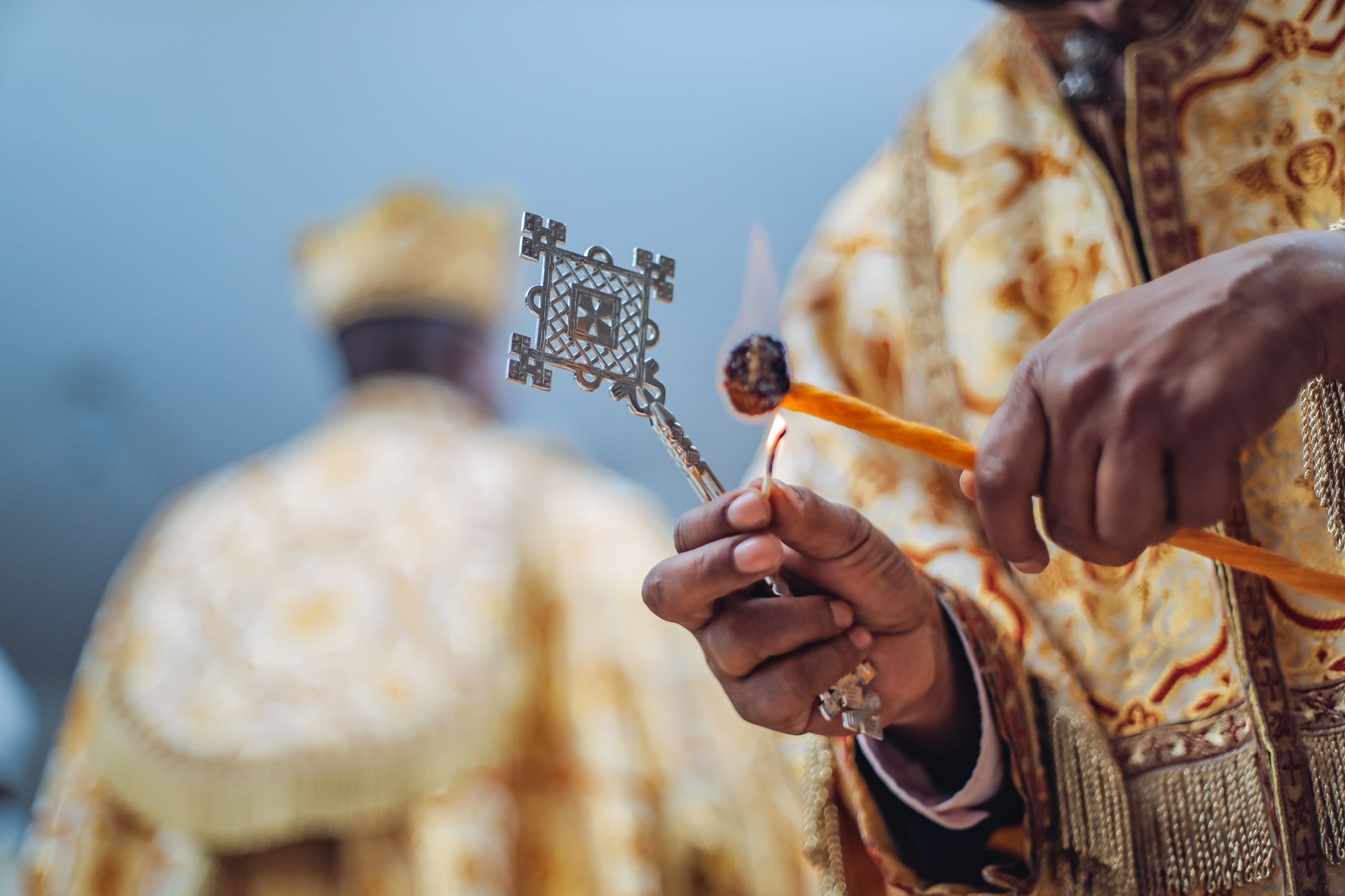
I was at Bete Maryam by 5:15 a.m., before the gate attendants had opened the main ticket booth, because the dawn liturgy doesn't wait for tourists. Priests in white and gold vestments chanted in Ge'ez, the ancient liturgical language, while deacons swung censers thick with frankincense smoke into the trench outside. I stood against the rock wall, well back from the worshippers, and said nothing. That restraint mattered more than anything else I did that week.
Afterward, over strong Ethiopian coffee at a stall near the entrance, our guide Mekonnen explained that photography during active services is generally discouraged unless a priest explicitly permits it, and that shoes come off before entering any church interior, not just the ones with carpet. He also mentioned something no guidebook had: Thursdays and Sundays draw the heaviest local attendance, so if a traveler wants fewer worshippers and more space to look, midweek afternoons are gentler.
The Southern Cluster filled the rest of the day: Bete Amanuel, with its facade cut to mimic timber-and-stone construction though it's a single piece of volcanic tuff; the half-collapsed Bete Merkorios, repurposed in parts as a prison centuries ago; and Bete Gabriel-Rufael, reached by a narrow bridge over a 10-meter drop that made my palms sweat more than the altitude did.
Bete Giyorgis and the Saturday market
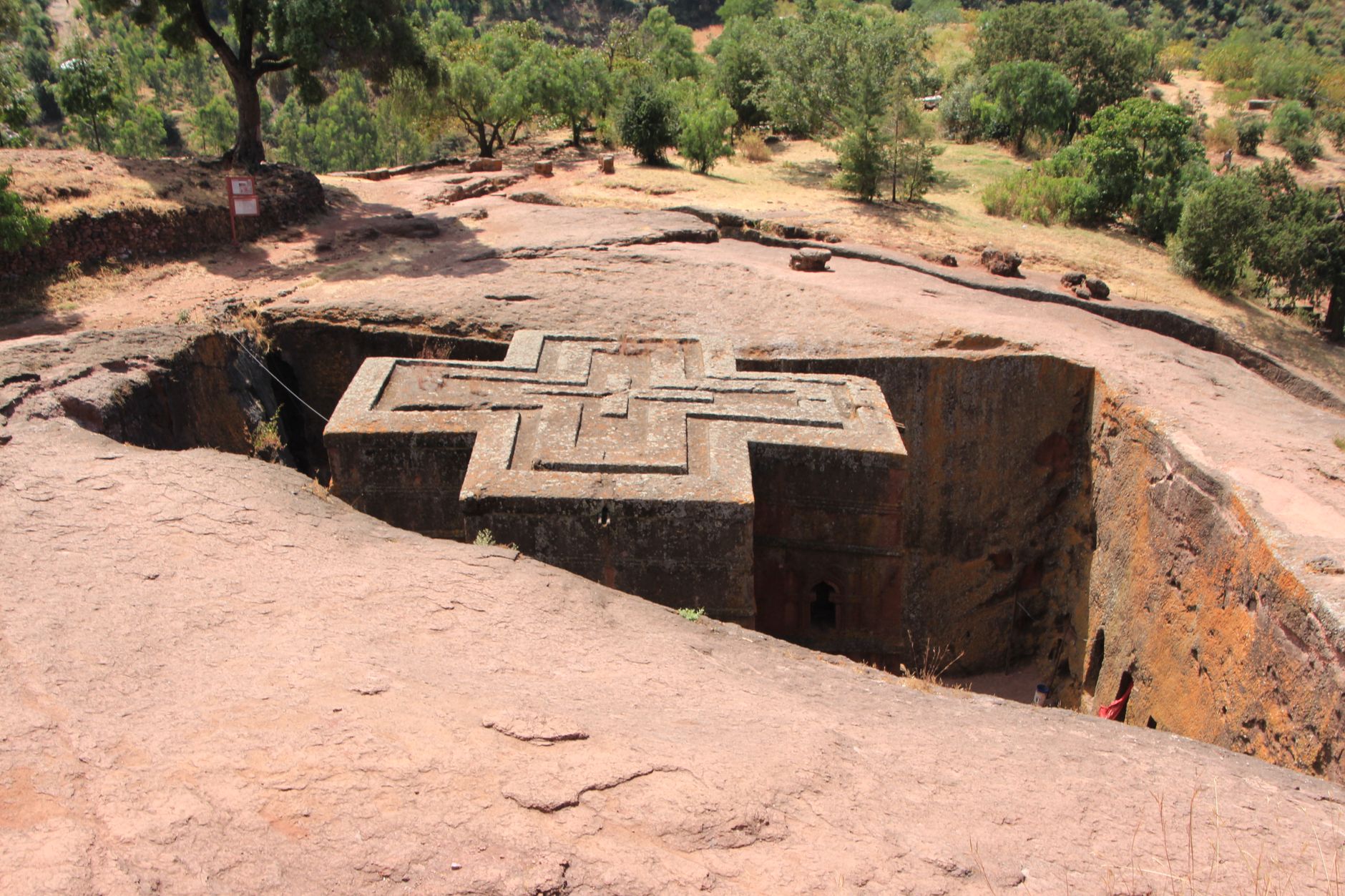
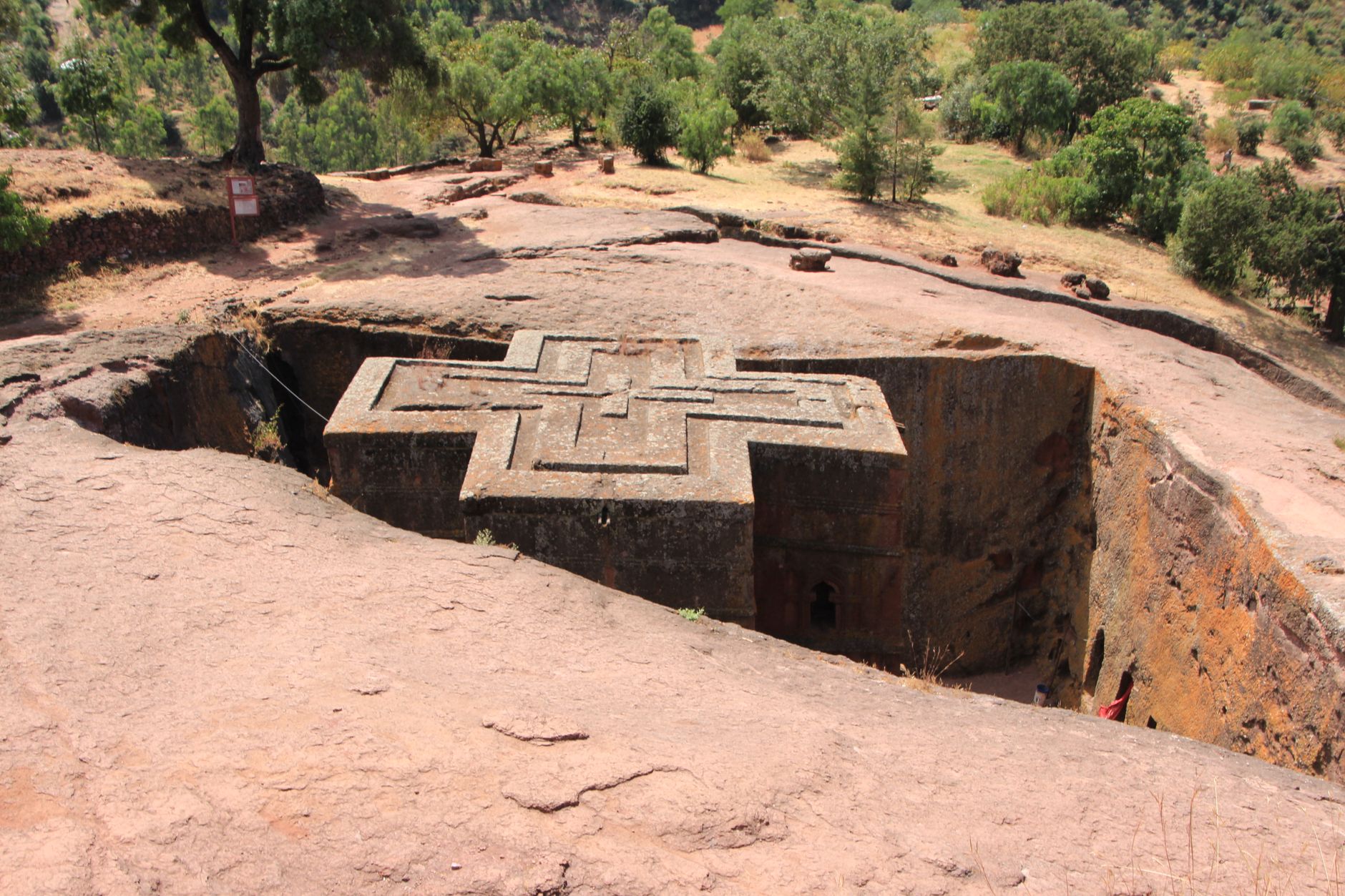
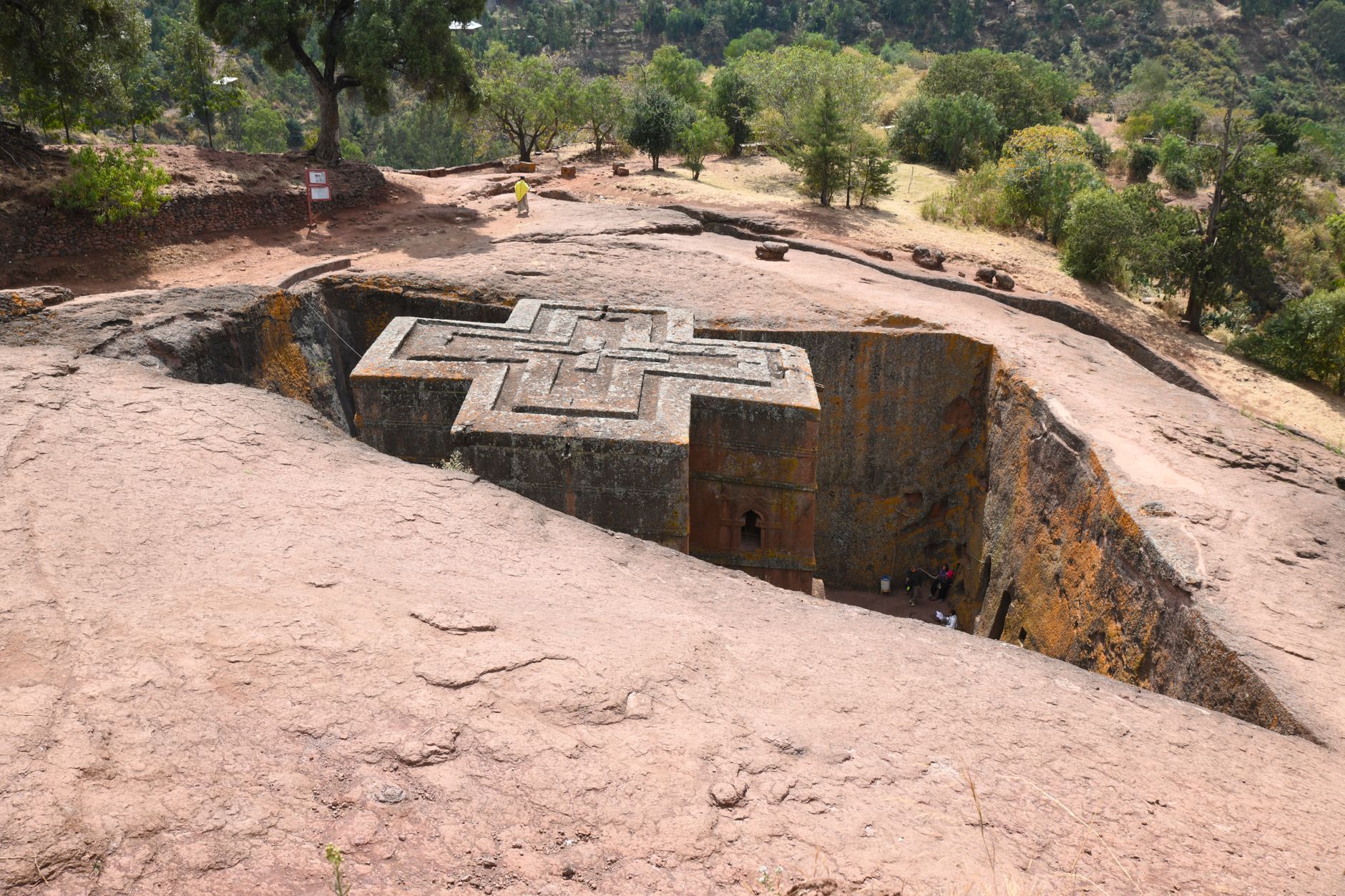
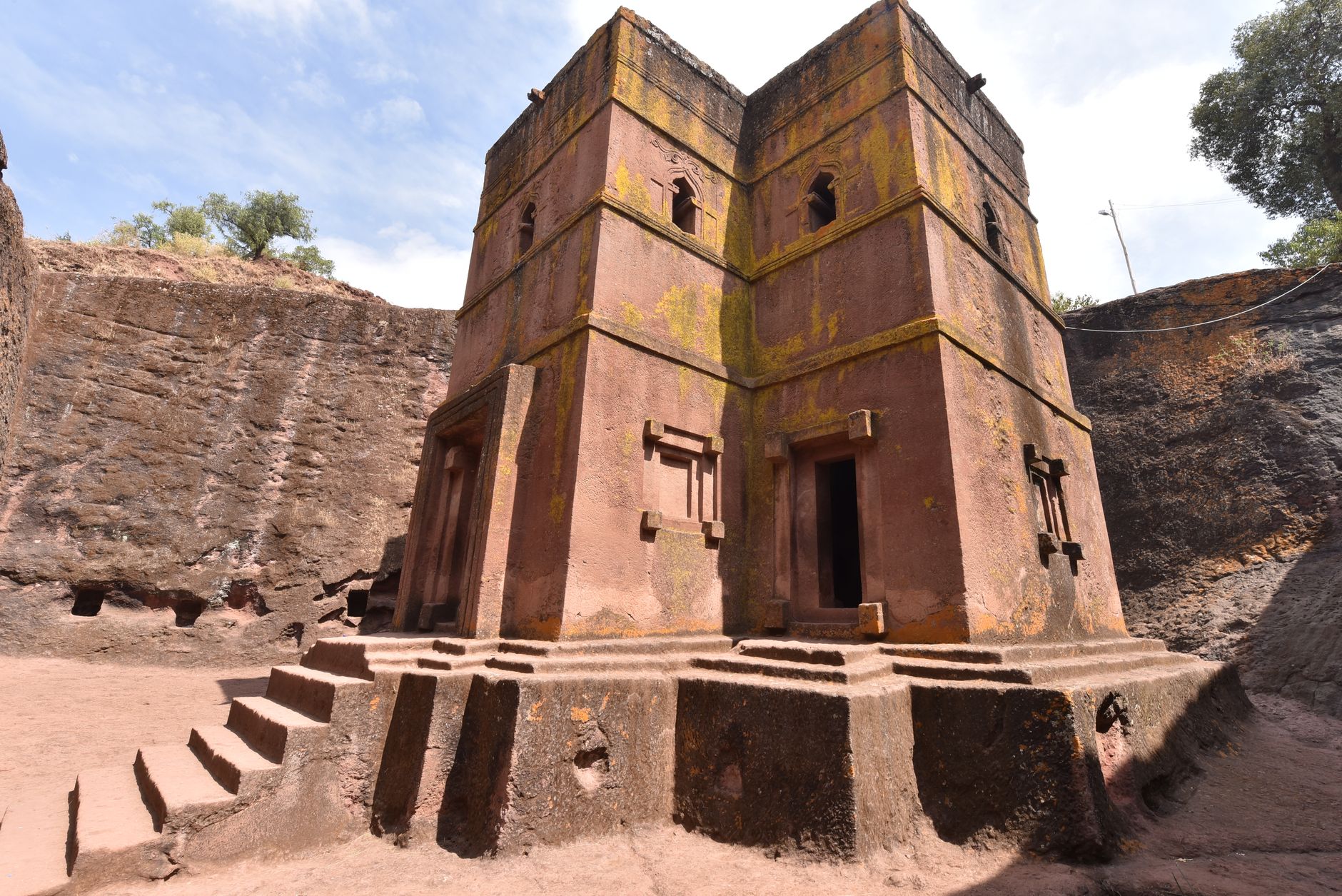
Everything in Lalibela points toward Bete Giyorgis eventually, and it deserves the wait. Carved last, according to local tradition, and set apart from the other two clusters, its cruciform roof sits flush with the surrounding plateau; you don't see the church until you're standing at the lip of the pit that surrounds it, looking down 12 meters at a cross cut whole from the rock.
I went twice: once at midday for the light straight down the shaft, and once near closing, around 5 p.m., when the crowds had thinned to a handful of pilgrims and the stone had gone the color of rust. A young priest sitting at the entrance let me look at a processional cross kept inside, heavy brass worn smooth at the grip, and told me it had been carried in Timkat processions for longer than anyone could date precisely.
Saturday is market day in Lalibela, and the open ground below town fills with sellers of teff, berbere, dried chickpeas, and the thin woven baskets called mesob. It has nothing to do with the churches and everything to do with why the town still works the way it does.
The trek to Yemrehana Krestos cave church
Yemrehana Krestos sits about 42 kilometers north of Lalibela, roughly a 1.5-hour drive on a road that turns to rutted dirt for the last stretch, followed by a 20 to 30 minute walk uphill to the cave mouth. We hired a 4x4 and driver through our guesthouse for around USD 60 to 80 for the round trip, shared among four of us.
Unlike Lalibela's churches, Yemrehana Krestos wasn't carved from rock; it was built, likely in the 11th or 12th century, from layered wood and stone inside a natural limestone cave, and it predates the Lalibela churches by most scholarly accounts. The caretaker priest unlocked the door himself and lit a single candle, since the cave has no electric light. Behind a low wall at the rear, in the dimness I could just make out mounds of bones, said to be the remains of pilgrims who asked to be buried near the site over centuries.
It was the quietest hour of the week. No queue, no other visitors that morning, just the priest's sandals on packed earth and the smell of beeswax candles. If Lalibela is the week's cathedral, Yemrehana Krestos is its crypt, and I'd argue it's worth the half-day detour more than a second lap of the Southern Cluster.
Asheton Maryam, a last church, and the road onward
The hike to Asheton Maryam monastery climbs roughly 3 kilometers up the escarpment above Lalibela, gaining several hundred meters, and it took our group close to three hours round trip at a slow, altitude-respecting pace. Mules can be hired at the base for anyone who'd rather ride the steeper sections, for a negotiated rate usually in the USD 10 to 15 range.
The monastery church itself is modest compared to the rock-hewn eleven, but the view back over Lalibela's tin roofs and terraced fields was worth the climb on its own. We came down by early afternoon, in time for a last walk through Bete Abba Libanos, tucked into a natural cave on the valley's edge and often overlooked by travelers racing through on a single day.
I'd built in this fifth day deliberately, after friends who'd rushed Lalibela in 48 hours told me they regretted it. Five days, with one spent entirely on Yemrehana Krestos and the hike, let the place settle rather than simply get checked off.
Images from the Lalibela churches
Cordelie travel advisors
Planning Lalibela? Go with someone who knows
The right suite, the right season, the reservations that never appear online — your Cordelie advisor knows them, and holds them for you.
Plan with a Cordelie advisorFree to ask. Cordelie Travel Services · IATA/ARC 06649064
Priests, Processions, and the Smell of Frankincense: What Stayed With Me
The standout wasn't any single church, however extraordinary Bete Giyorgis looked at 5 p.m. with the light low across the pit. It was the ordinariness of it all to the people actually there: a priest adjusting his vestments by feel in a dark passage he's walked ten thousand times, a woman unwrapping injera for her grandmother to eat seated on the stone steps outside Bete Maryam, a boy practicing a hymn under his breath while waiting for his father.
The second thing that stayed with me was how physically demanding the week was, in a way nobody had warned me about. Lalibela sits at roughly the altitude of Lhasa's lower valleys, and the stone stairways between churches are uneven, sometimes slick, occasionally requiring you to duck through passages barely a meter and a half high. Pace yourself the way you would at altitude anywhere: short days at first, water constantly, and no shame in sitting out an afternoon.
Etiquette is not complicated but it is non-negotiable. Remove shoes before any church interior, dress modestly with shoulders and knees covered, and lower your voice to something close to a whisper once inside the trench system, even between churches. Ask before photographing a priest or an active service, and expect that sometimes the answer will be a polite no. A small donation, often placed in a box near the entrance, is appreciated but never assumed.
Shiro, Tej, and Fasting Food: Eating Through Holy Week
Much of Lalibela observes the Ethiopian Orthodox fasting calendar, which rules out meat and dairy on Wednesdays, Fridays, and often much of the lead-up to Fasika, the Ethiopian Easter that frequently falls in spring. That made the vegetarian fasting plates, called the beyaynetu, the default rather than the exception: a wide injera platter ringed with shiro (a spiced chickpea stew), misir wot (red lentils), gomen (collard greens), and tikil gomen (cabbage and carrot) at places like Ben Abeba, perched on a hillside outside town with sweeping valley views, where a generous beyaynetu runs somewhere in the USD 5 to 8 range.
On non-fasting days, Seven Olives Hotel's restaurant did a reliable doro wat, the slow-simmered chicken stew in berbere sauce served with a boiled egg, while a smaller place called Lasta Lalibela Restaurant near the airport road served tibs sizzling on a clay pot straight from the kitchen. For drink, tej, the honey wine, is poured from recycled bottles at small houses around town, often cloudy and sharp, closer to mead than wine; it's worth trying once in moderation, since the alcohol content varies house to house with no label to warn you.
Coffee here is not an afterthought. A proper Ethiopian coffee ceremony, roasting green beans over coals and brewing in a clay jebena, can take 30 to 45 minutes from first roast to third pour, and more than one guesthouse offered it unasked, simply as hospitality rather than a transaction.
Dawn services, private access to Bete Giyorgis before the gates open to the public, and a seat with a local priest willing to explain a liturgy in English are not things a booking site can arrange. A Cordelie advisor builds that into your week from the start: private transfers to Yemrehana Krestos timed to beat the midday heat, a stay paired with the Simien Mountains or Gondar's Royal Enclosure so the week reads as one unhurried arc rather than three disconnected stops, and the kind of introductions that turn a church visit into a conversation.
If you want the week to end at Simien Lodge watching Gelada baboons graze the escarpment at 3,260 meters, or to start in Gondar walking the frescoed ceiling of Debre Birhan Selassie before you ever see a rock-hewn church, that's the itinerary a Cordelie advisor crafts, built around how you actually want to move through northern Ethiopia.
Is a week in Lalibela the right trip for you?
Best for travelers drawn to living religious sites, who want depth over a checklist and don't mind a demanding, high-altitude week of walking and early mornings.
Five days in Lalibela, including the half-day out to Yemrehana Krestos, gave the place room to be a town with a life rather than a museum with an entry fee. The eleven churches alone could fill three days; stretching to five let the dawn services, the market, and the hike up to Asheton Maryam fit without rushing.
This is not a trip for travelers who want fast-paced sightseeing or reliable luxury infrastructure; rooms in town are simple, roads are rough, and electricity can flicker. It rewards travelers who come for the Ethiopian Orthodox tradition itself, who are comfortable with early starts around 5 a.m. and modest dress, and who'd rather spend a week here than a week split thinly across half of Ethiopia.
Paired with three or four nights in Gondar and the Simien Mountains, the full week becomes one of the more rewarding cultural circuits in East Africa, and one that benefits enormously from a planner who already knows which doors open for a quiet word and which don't.

Alex Moreau writes about going slowly. Nine years of reporting from trains, river boats and towns nobody has a hashtag for, mostly across Europe and North Africa. They live in Lisbon, keep a running list of the continent's best two-hour lunches, and believe most itineraries would improve if you deleted a city.